The Lubricant Industry's Inflection Point: Shifting to Low-Carbon, Selling Sustainability
By Mr. Sakesan Krongphanich, Deputy Chief Executive Officer
P.S.P. Specialties Public Company Limited (PSP)
The year 2025 marked a pivotal turning point when major global automakers began mandating suppliers to report Product Carbon Footprint (PCF) with verifiable emission data across production chains. Simultaneously, the European Union's regulatory framework—including CBAM, CSRD, and ESPR—is pushing upstream suppliers, including lubricant manufacturers, into direct focus. The lubricant industry is being inexorably drawn into the Low-Carbon Economy equation.
New Landscape: From "Price" to "Life Cycle Performance"
For decades, the lubricant industry competed primarily on two factors: price and performance. But today, the equation has changed. As industries worldwide accelerate toward Net Zero targets, environmental regulations tighten, and ESG standards become critical trade conditions, competition has shifted to three new dimensions: technology, sustainability, and life cycle performance. Manufacturers capable of developing solutions that enhance machinery efficiency while reducing environmental impact will play crucial roles in supporting industrial sector transition to a low-carbon economy.
Many countries and key markets have begun establishing Product Carbon Footprint standards for industrial products, meaning every component in the production chain—including lubricants—must be traceable and able to report carbon footprints. This compels manufacturers to develop products meeting environmental and sustainability standards to support future exports to global markets.
Sustainable Specialties Approach: Four Battlefronts in the Low-Carbon Era
PSP, as a regional leader in lubricants and specialty solutions, is advancing its Sustainable Specialties approach by developing products that address both operational performance and global ESG market standards. Drawing from industry experience, PSP focuses on four critical battlefronts:
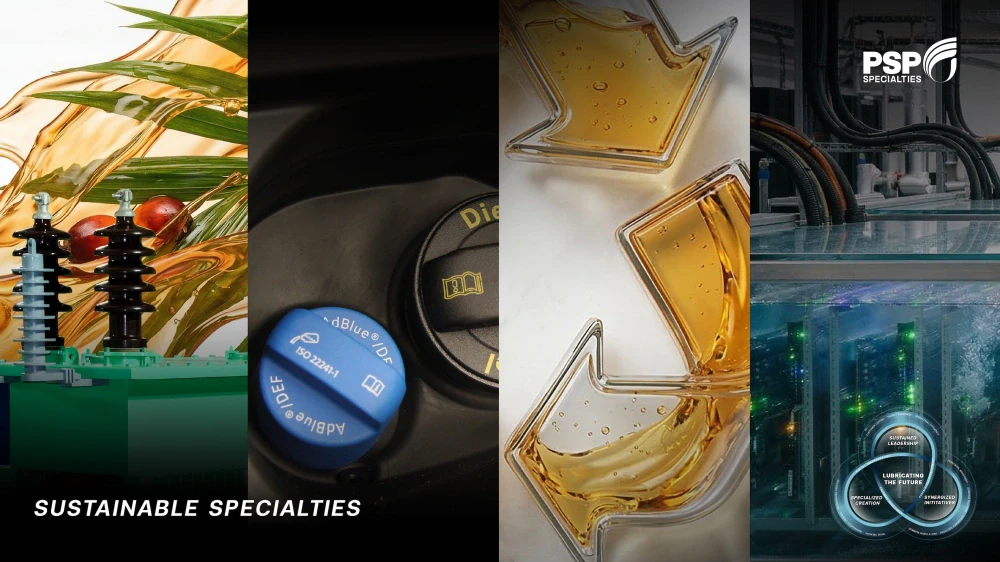
1. Bio-based Products for Energy Infrastructure Transformers are the heart of power distribution systems, but conventional transformer oils have limitations in biodegradability. One key innovation is the development of Bio Transformer Oil under the ENPAT product line, which PSP has researched and developed in collaboration with the National Science and Technology Development Agency (NSTDA). The focus is on creating transformer fluids with high biodegradability, reduced environmental risk, and alignment with modern energy infrastructure demands that increasingly prioritize sustainability.
2. Clean Emission Solutions for Transportation According to IPCC reports, the transportation sector accounts for approximately 15% of global greenhouse gas emissions. PSP supports pollution reduction in this sector through AdBlue production, a fluid for Selective Catalytic Reduction (SCR) systems that reduces nitrogen oxide (NOx) emissions from diesel engines. It represents a critical component in elevating modern vehicle emission standards.
3. Circular Economy Through Re-refined Base Oil Used lubricant oil is not waste—it is a resource awaiting reuse. PSP has investment plans for Re-refined Base Oil (RRBO) projects to recycle used lubricant oil back into high-quality raw materials. This approach drives Circular Economy in the lubricant industry, reducing waste, minimizing new resource consumption, and lowering carbon emissions throughout the supply chain.
4. Cooling Solutions for the Digital Economy Data centers represent the fastest-growing infrastructure of this era but consume enormous energy. PSP is developing Immersion Cooling Fluid for data centers, a next-generation cooling technology that enhances data center energy efficiency, supports digital economy growth, and helps reduce the carbon footprint of IT infrastructure over the long term.
Opportunities for Thai Industry
This transition is not merely a challenge but a significant opportunity with proper preparation. Thailand has a strong manufacturing base, expertise in specialty lubricants, and research and development potential in collaboration with national research institutions. What's needed is a shift from selling only "performance" to creating "sustainable performance" for customers.
The lubricant industry may not make headlines as frequently as renewable energy or electric vehicles, but it is a critical gear driving the entire economic machinery. And when the world demands machinery that is more energy-efficient, emits less pollution, and operates under stricter standards, players in this industry must also move faster than before.
Under its sustainability vision, PSP is committed to developing products and solutions that balance industrial efficiency, environmental stewardship, and economic growth. The company is expanding its Sustainable Specialty Solutions portfolio to support the industrial sector's transition to a Low-Carbon Economy and strengthen the long-term global competitiveness of Thai industry.